
The Rabbit in the Moon.
Jūgoya — a night of moonlight, harvest, and stories.
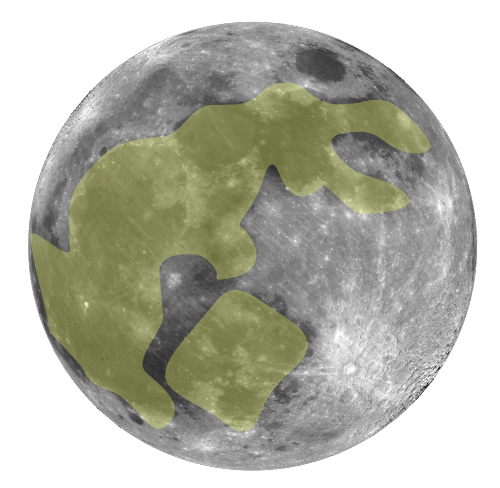
There is a rabbit on the moon.
At least, that is what many people in Japan have seen there for generations.
On the fifteenth night of the eighth month according to the old lunar calendar, Japan celebrates Jūgoya, literally “the fifteenth night.” It is also known as Chūshū no Meigetsu, the Mid-Autumn Moon.
Today, Jūgoya falls sometime between September and October on the modern calendar, so the date changes from year to year. And although the moon on Jūgoya is not necessarily a perfect full moon, it has long been regarded as one of the most beautiful moons of the year.
A Night for Looking Up
The tradition of moon viewing, or tsukimi, is thought to have come to Japan from China more than a thousand years ago.
During the Heian period, court nobles held elegant moon-viewing gatherings, drinking, composing poetry, and listening to music beneath the autumn moon. Rather than simply looking up at the sky, they might admire the moon reflected in water or even in a sake cup.
Over time, moon viewing moved beyond the imperial court and became part of everyday life. It also took on a deeper connection with the autumn harvest — a time to give thanks for the food that had been gathered from the fields.
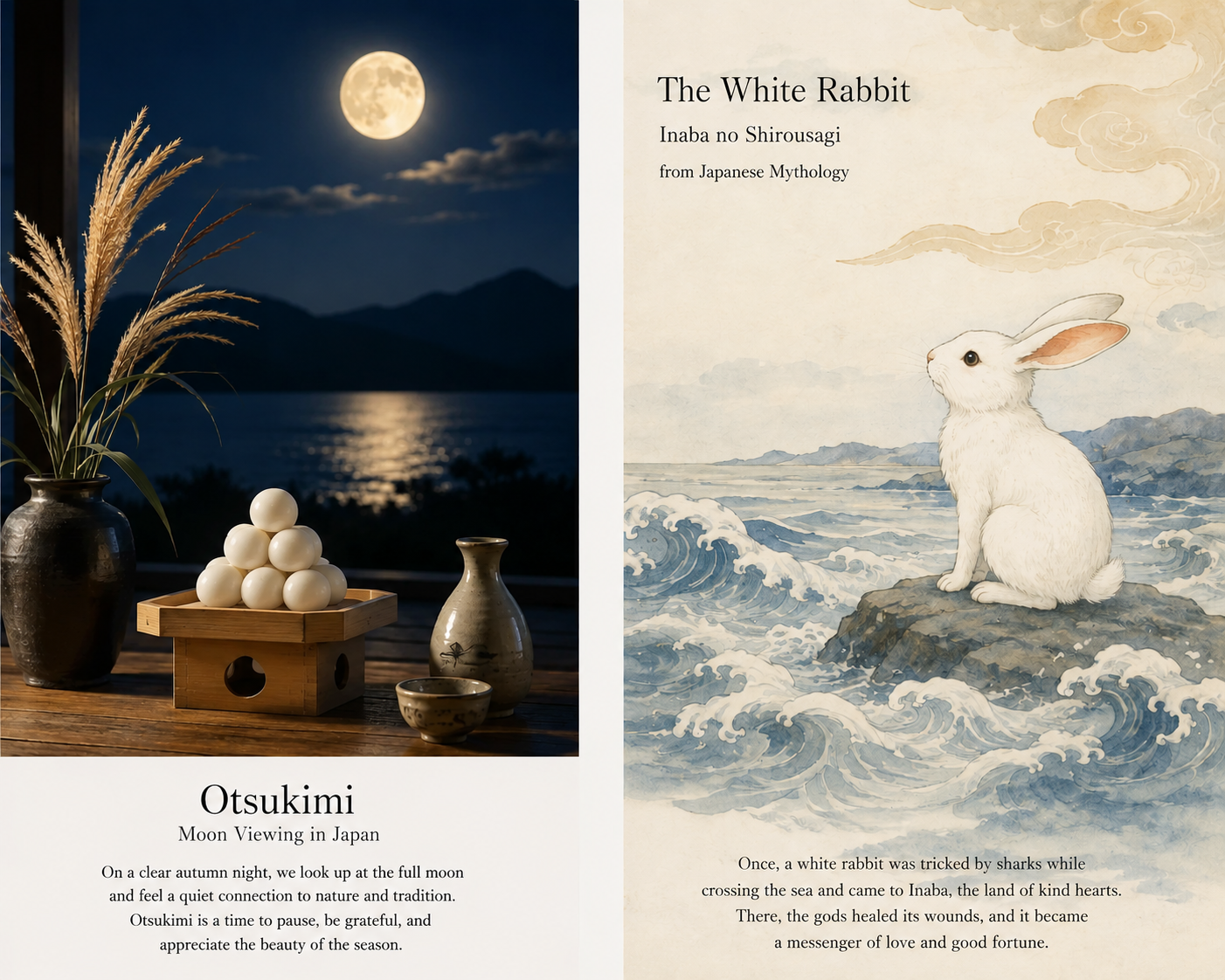
At home, offerings may include tsukimi dango, small white rice dumplings shaped like the full moon, along with seasonal produce such as taro, sweet potatoes, chestnuts, grapes, or pears. Susuki, Japanese pampas grass, is also traditionally displayed, its long stems resembling the ears of ripening rice.
There is something rather lovely about that.
Before electric lights filled our evenings, the moon itself was part of daily life.
So perhaps it was natural to stop for a moment and look up.
So, Why Is There a Rabbit?
Look carefully at the patterns on the moon and, in Japan, you may be told that you are looking at a rabbit pounding mochi.
The story behind it is much older than Japan.
One of the best-known explanations traces the moon rabbit to an ancient Buddhist tale from India. A rabbit, a monkey, and a fox encounter a hungry old man and each tries to find something to give him.
The monkey brings food.
The fox brings food.
The rabbit can find nothing.
With nothing else to offer, the rabbit throws itself into a fire, offering its own body instead.
The old man is revealed to be a divine being who had come to test them. Moved by the rabbit's selflessness, he places its image on the moon, where it can be remembered forever.
The story travelled across Asia and became part of different cultural traditions.
In China, the rabbit became associated with making the elixir of immortality.
In Japan, the image changed again.
Here, the rabbit is usually imagined as pounding mochi — rice cakes — with a wooden mallet.
And somehow, a rabbit making rice cakes on the moon feels perfectly at home in a Japanese autumn evening.
Another Rabbit, Much Closer to Home
Japan had another famous rabbit long before today's moon-viewing imagery became familiar.
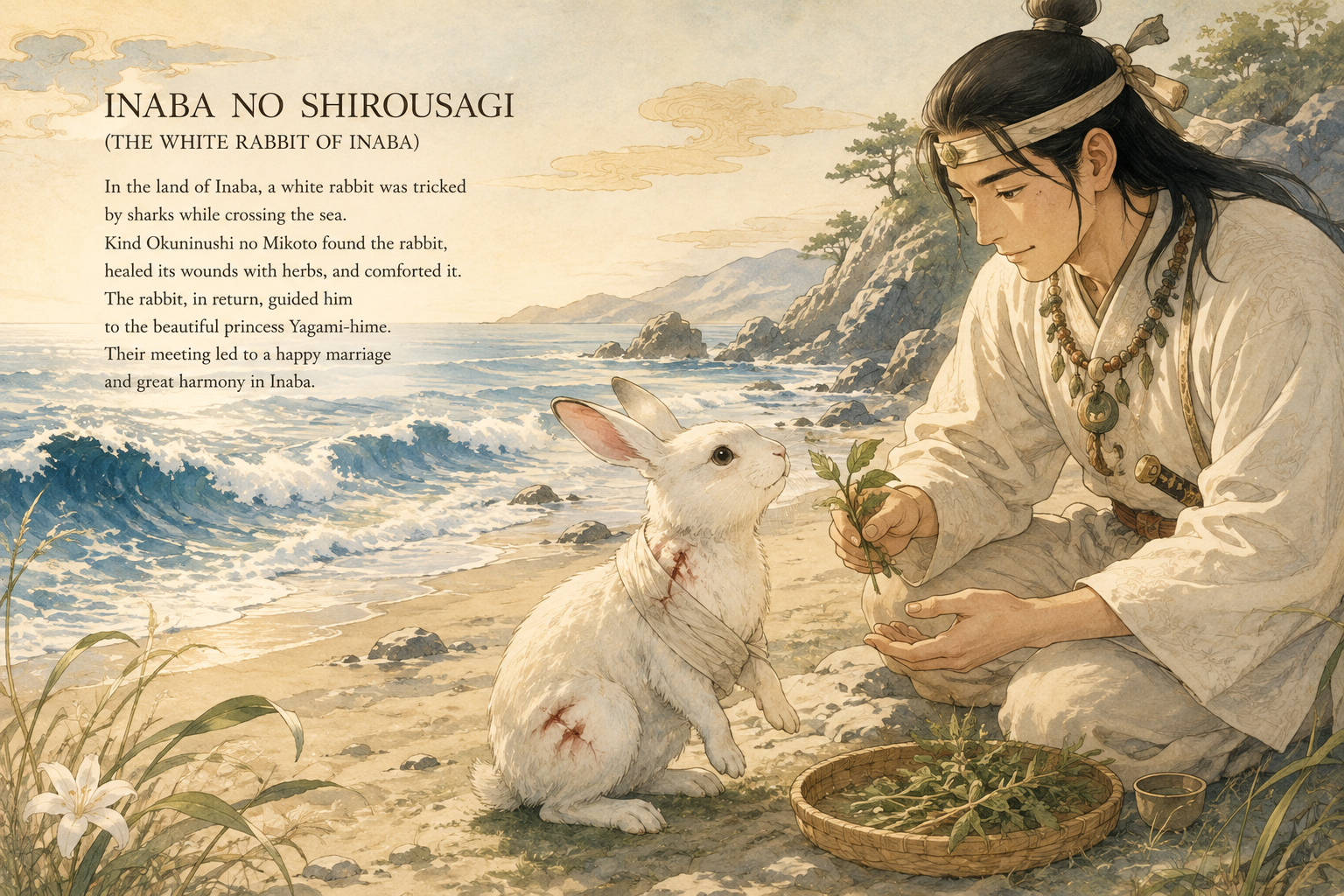
In the Kojiki, Japan's oldest surviving collection of myths, there is the story of the White Rabbit of Inaba.
The rabbit is found badly injured after crossing the sea and being deceived by a group of crocodile-like creatures known in the story as wani. Several gods pass by, but it is Ōkuninushi who listens to the rabbit and tells him how to heal his wounds.
The rabbit later foretells Ōkuninushi's successful marriage to Yagami-hime.
And there is a fascinating detail in the Kojiki: the rabbit is described as being known as Usagigami — the Rabbit Deity.
That does not necessarily mean that rabbits were universally regarded as sacred animals in ancient Japan.
But it does tell us something interesting.
The rabbit in Japanese mythology was capable of being much more than an ordinary animal.
It could suffer.
It could be healed.
It could know what was yet to come.
And, at least in this story, it could become a deity.
There are also theories that the tale of the White Rabbit of Inaba belongs to a much wider family of animal stories found across Asia, suggesting that stories — like animals themselves — have never been particularly interested in staying inside borders.
One Moon, Many Stories
Perhaps the most fascinating thing about the moon is that we all look at the same one.
And yet, we do not always see the same thing.
In Japan and China, many people see a rabbit.
Elsewhere, people have imagined a man, an animal, a face, or other shapes in the patterns of the lunar surface.
The moon has not changed.
Only the story has.
Maybe that is something humans have always been good at: looking at something familiar and finding another world inside it.
Which brings us to two rather unexpected rabbits.
Follow the Rabbit
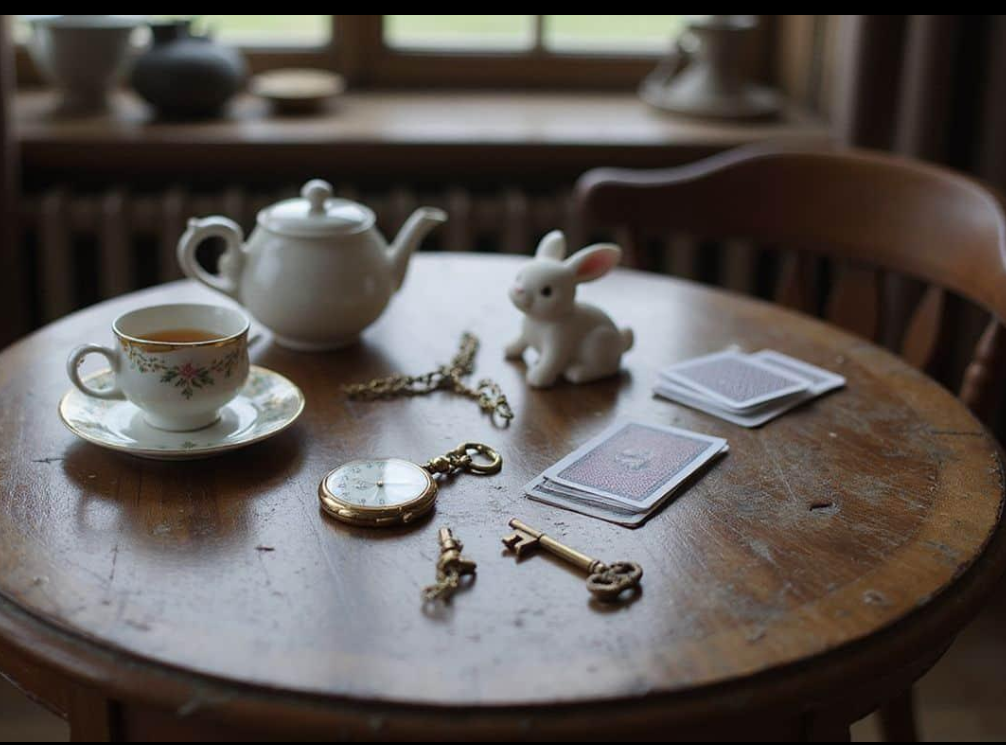
In Alice's Adventures in Wonderland, Alice follows a White Rabbit and falls down a rabbit hole into a world where almost nothing behaves as it should.
More than a century later, another famous story would use a white rabbit as a sign that something is not quite what it seems.
In The Matrix, Neo is told to follow the white rabbit. Soon after, he notices a woman with a white rabbit tattoo and follows her into a reality far stranger than the one he thought he knew.
Neither story has anything to do with the Japanese moon rabbit.
And yet the image feels strangely familiar.
A rabbit appears.
You follow it.
And suddenly, the world looks different.
Perhaps that is why rabbits make such compelling guides into stories. They are small, curious, slightly elusive — and somehow always seem to be heading somewhere we have not yet been.
A Night to Look Up
Back in Japan, there is no rabbit hole to fall into.
Just an autumn night.
A quiet moon above the rooftops.
Susuki grass moving gently in the evening air.
A small arrangement of white dango on a table.
And perhaps, if you look long enough, a rabbit quietly making mochi somewhere on the moon.
Jūgoya began as a tradition of moon viewing, but it became something more — a moment to appreciate the changing season, give thanks for the harvest, and pause beneath the same moon that people have looked upon for centuries.
The moon is still there.
The rabbit is still there.
Only the stories keep changing.
We all look at the same moon.
We simply don't always see the same story.
↓ Enjoy chilled sake while summer lasts.
