In Kyoto, more than a thousand years ago, a scholar said goodbye to the plum tree in his garden. He was about to be sent into exile, far from the capital, with no certainty that he would ever return.
Before leaving, he composed a poem for the tree:
When the east wind blows, send me your fragrance.
Do not forget the spring, even when your master is gone.
The Tree That Would Not Stay Behind
According to legend, the tree did not forget.
It tore itself from the earth and flew through the night, all the way to Dazaifu, where it bloomed beside him in exile.
A tree, longing for the person it had been left behind with.
The plum tree at Dazaifu Tenmangū is still known as Tobi-ume, the Flying Plum. In Kyushu, it is said to be among the first plum trees to announce the arrival of spring.
A Heart Allowed to Live Anywhere
I grew up with this way of seeing the world.
In Japan, a heart can be found anywhere — in a tree, in a stone, in an old tool worn smooth by someone's hands. There is a sense that even the things around us can hold something beyond their physical form: memories, affection, and the traces of the people who have cared for them.
Nothing loved is ever truly left behind.
The scholar was Sugawara no Michizane, and his story is about more than loyalty. It speaks of a way of seeing in which things are never merely things.
This is one of the things I have always wanted to share about Japan — not as something to be explained, but as a feeling I have grown up with.
The Artwork
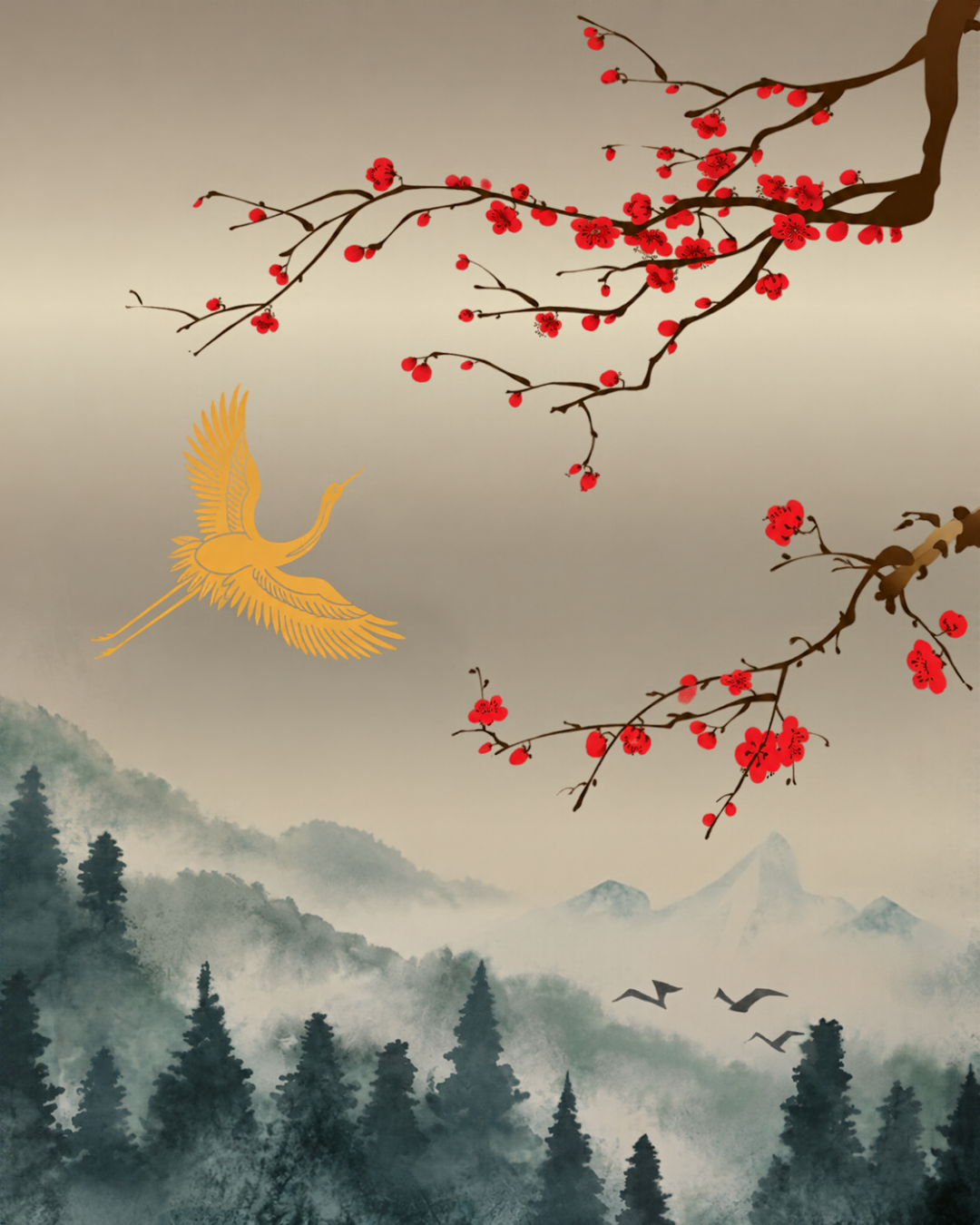
In my artwork, TOBI-UME, a plum branch sweeps across the sky as a golden crane crosses mist-covered mountains.
I did not want to depict the tree literally taking flight. Instead, I wanted to give shape to the feeling of flight itself — the longing, the devotion, the pull of a bond that distance cannot break.
The red of the blossoms and the gold of the crane emerge from the quiet mist, much like a memory that remains vivid against the passing of time.
What Remains
Perhaps that is why this legend has endured for so long.
It does not ask us to believe that a tree can fly. It invites us to consider what it means to be missed — and remembered — so deeply that even a tree might cross the night to be near someone again.
To me, that is the beauty of the story.
And perhaps, in its own quiet way, it is also a glimpse of how I have learned to see the world.